INDUSTRY:
HEALTHCARE DESIGN
YEAR:
2026
TIMELINE:
9 MONTHS
EXPERIENCE:
INTERACTION/EXPERIENCE, PRODUCT DESIGN
overview.
Hospitals are full of elements that quietly shape how we feel: the pitch of a monitor, the texture of a gown, the glare of a light. For many patients, these sensory cues become linked with anxiety, fear, and discomfort. My graduate design thesis began with the question: what would happen if these same cues were reframed from stressors into prompts for imagination?
Instead of intervening in clinical care, this project looks at what surrounds it, exploring how medical spaces might invite curiosity, comfort, and even wonder. The question became less about the cues themselves and more about exploring new forms of interaction within the care environment, leading the project towards play.
As adults, we often lose comfort with the open-ended play that we excelled at as children, focusing instead on goals, outcomes, or correctness.
Within Reach is a speculative bedside interaction system designed for elderly patients with limited lower-body mobility, where small, accessible movements can produce open-ended visual responses..
The speculative framing reflects an emerging condition: patients who remain cognitively present, but cannot interact with precision. As healthcare environments become more technologically responsive, interaction risks becoming more demanding rather than more accessible. This project asks what interaction might look like if it were instead open-ended, expressive, and low-pressure.
This is a play-first interaction system where image-making can emerge, but is never required. Instead of centering precision, it prioritizes interaction that feels open, forgiving, and easy to enter.
challenge.
The first thing that comes to mind when I think of the patient experience is not pain, but time. Time that stretches and slows, blurring under fluorescent lights. Most medical visits are not painful in the physical sense; they are draining emotionally. It is the never ending waiting that wears on people. Waiting to check in, waiting to be called, waiting in the exam room, waiting for the nurse at the end of the visit, waiting for prescriptions. In hospitals, waiting can expand into days or weeks.
I used to volunteer frequently in inpatient hospital units and spent hours sitting with patients who could not move much, often elderly patients recovering from injuries. They would lie in the same hospital bed for days, or even weeks, at a time. I remember one patient lying in bed, tv off, staring at the ceiling. She said “There’s nothing to do… I’ve watched so much TV since coming here, I can’t watch anymore.” Her words stayed with me and changed the way I thought about care.
At that time, I was pre-med and certain I wanted to become a physician to heal people. However, while volunteering in hospitals, I began noticing more than just illness. I noticed the environment – the air, the sterile, chemical smells, the constant background hum, a claustrophobic stillness despite the constant hospital activity. I dreaded going to the hospital even though I was just a volunteer, not even a patient. I realized I was interested in more than just treating the body – I wanted to change the experience and feel of being a patient. I wanted to care for the mind and bring a sense of emotional ease into these medical spaces that often heighten stress.
research.
I examined how pediatric healthcare spaces have evolved over time as a way to understand what my own thesis environment could become. I collected and analyzed photographs of pediatric and elderly hospital rooms from the 1900s to the 2020s and visualized them in a timeline collage. My research revealed that pediatric units have been studied and developed far more extensively than elderly care spaces, exposing a significant gap in design attention and research dedicated to improving the experiences of older adults.

Multi-generational interviews
To better understand how future care environments might support comfort and connection, I conducted interviews with young adults, middle aged adults, and elderly adults, learning what different generations consider emotionally fulfilling in their ideal elderly care spaces. The responses revealed a strong desire for nostalgic activities and familiar comforts. I also noticed that participants consistently relied on elements already present in existing elderly care facilities or on technologies that already exist. Instead of imagining radically different forms of care, most people reproduced the current landscape of care. This revealed how people’s visions of future care are constrained by what they already know, suggesting that designing for future elderly wellness requires expanding beyond user expectations to introduce new emotional possibilities.
world building.
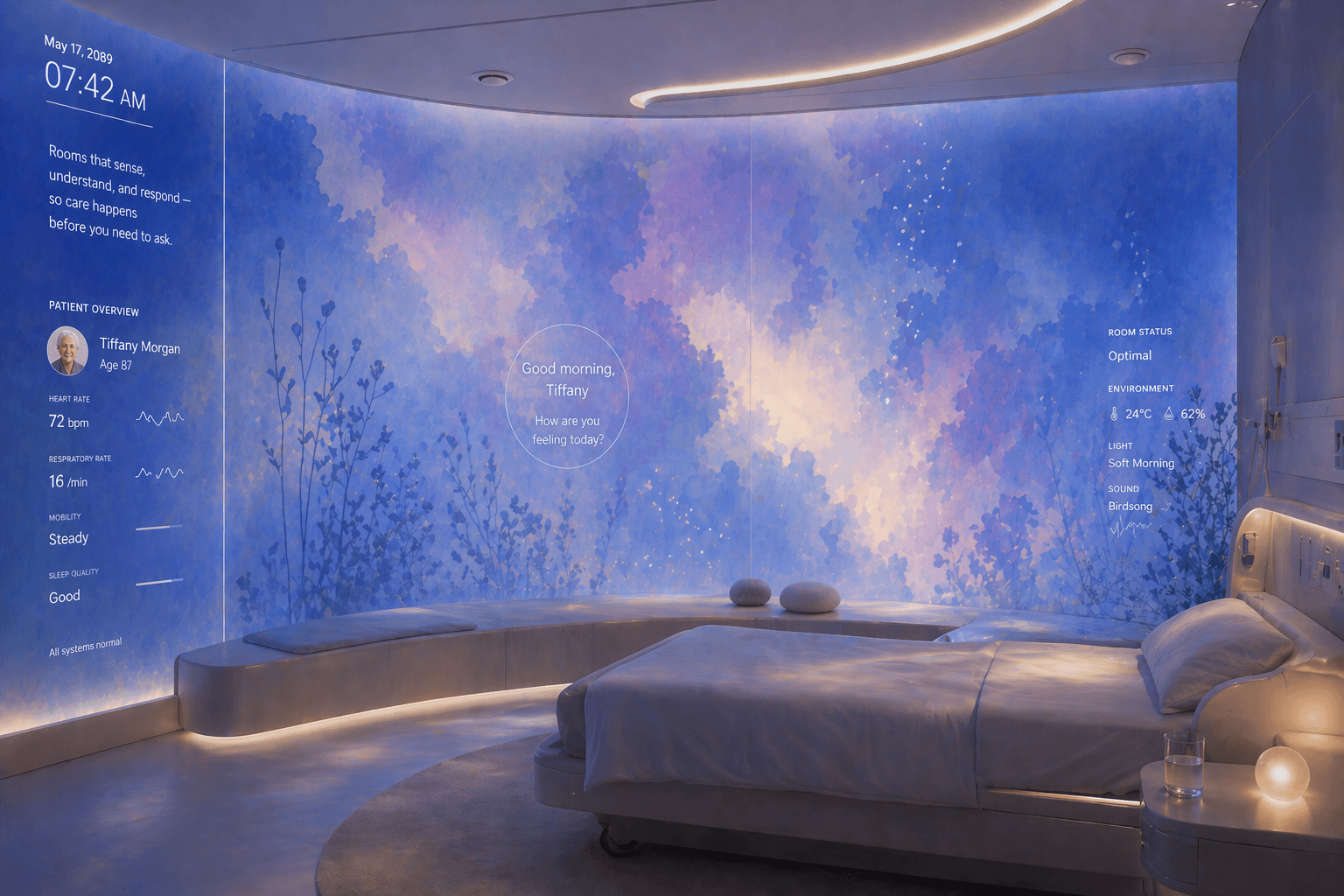
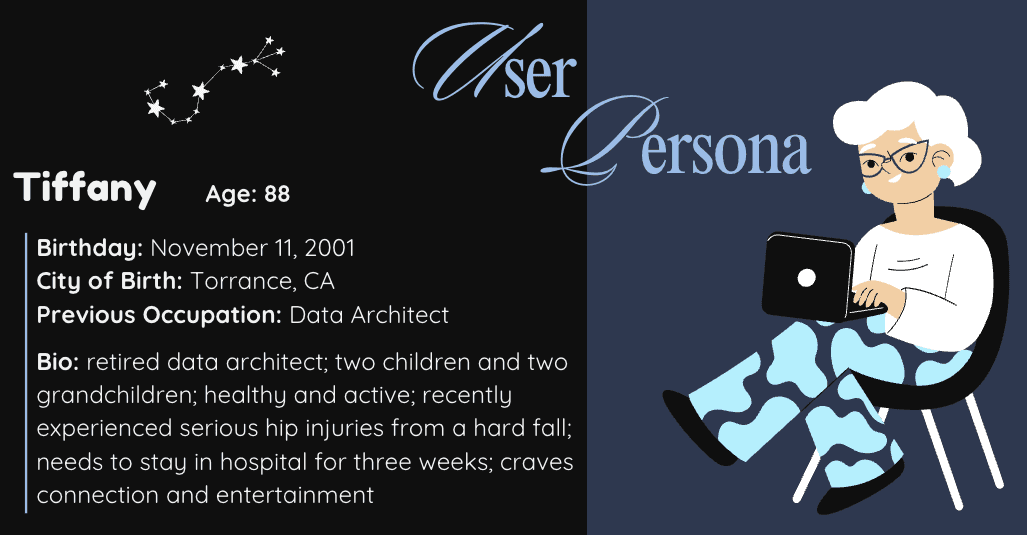
The year is 2089. People are living longer, healthier lives, and more patients remain cognitively present well into older age.
Hospital rooms are highly responsive environments, equipped with advanced sensors that track subtle movement and physiological signals. Instead of a mounted TV, the entire wall can display information, support communication, and provide interactive experiences.
Target Audience:
My project is designed elderly patients with limited lower-body mobility who remain mentally engaged, but cannot interact with precision. It is intended for patients who have the energy and desire to engage, but are limited in how they can physically interact. As digitally fluent generations age into the healthcare system, passive entertainment becomes less satisfying, but many existing interfaces still require accuracy, control, or sustained effort.
This creates a gap: patients who want to engage, but cannot comfortably interact through conventional means. In this context, the challenge is no longer access to technology, but the nature of interaction itself.
result.
The final concept centers on doodling as a form of interaction, an open-ended, familiar activity that invites imagination without pressure.
This direction was shaped by physical constraints. Many elderly patients I observed were too fatigued to move around, but could still move their arms. Upper-body movement and control requires less energy and is often preserved longer, making it a more accessible entry point for interaction.
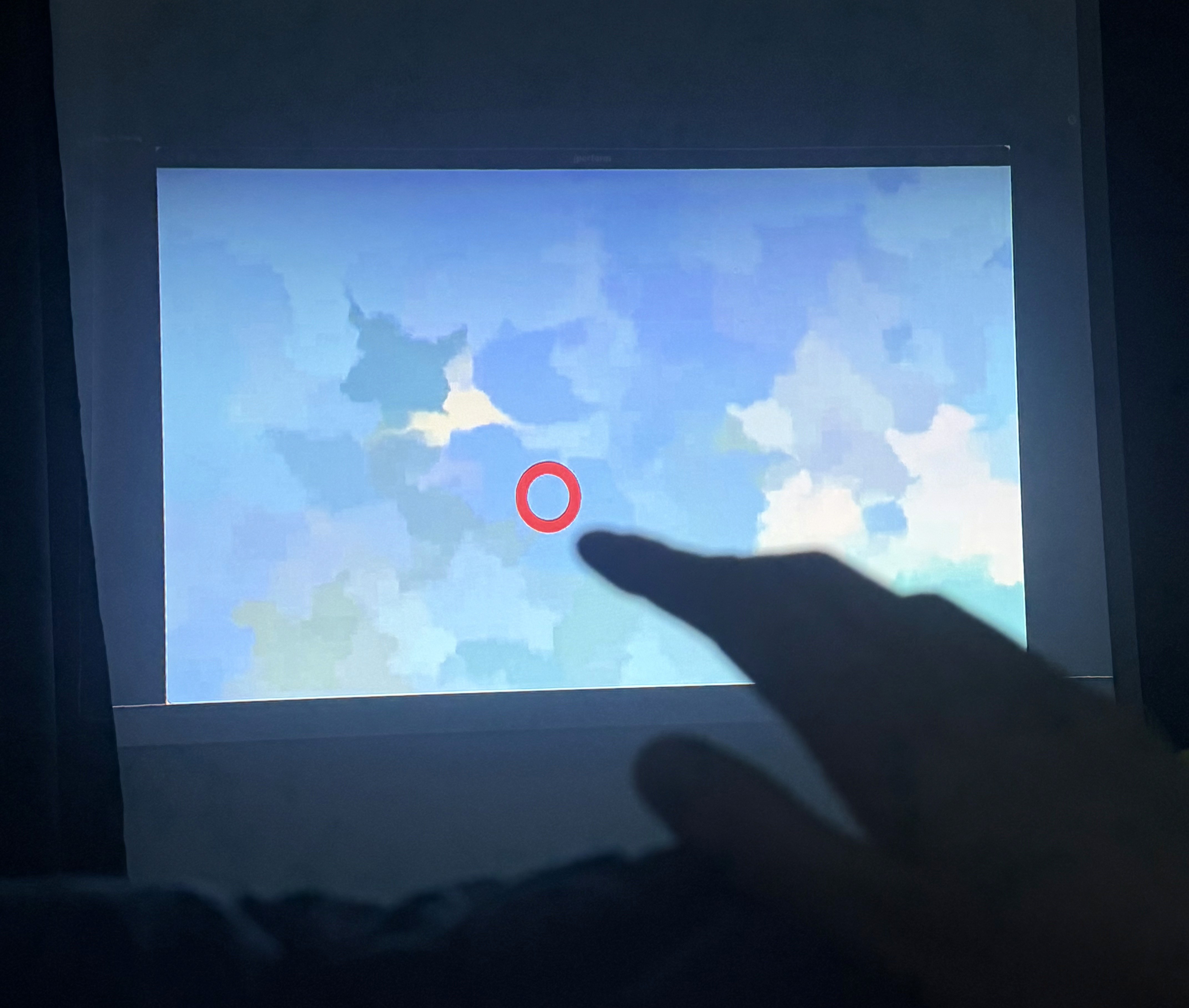
The system uses a watercolor-inspired brush that diffuses and spreads color in response to movement. Its unpredictability encourages interpretation, like looking at clouds and imagining new shapes and stories, rather than control, shifting the focus from producing an outcome to engaging in the process. By removing precision and control, the interaction becomes reactive and forgiving, shifting the focus from producing an outcome to engaging in the process.
Doodling also supports cognitive and emotional wellbeing. It has been shown to help maintain attention, support memory, and relieve stress through simple, repetitive movement.
Together, these decisions create an interaction that is easy to enter, physically accessible, and grounded in play rather than performance.